Shifting Gears in Life Sciences: CSV vs. CSA Explained
CSV v CSA in the FDA context.
For decades, software validation in the FDA-regulated life sciences industry meant one thing: mountains of paperwork. Companies often spent more time formatting screenshots than actually testing their software.
The FDA recognized this burden and introduced a modern framework to shift the industry's focus. It moves companies away from rigid compliance and toward patient safety.
Here is a breakdown of the differences between the traditional Computer System Validation (CSV) approach and the modern Computer Software Assurance (CSA) framework.
Traditional CSV: The Paperwork Trap
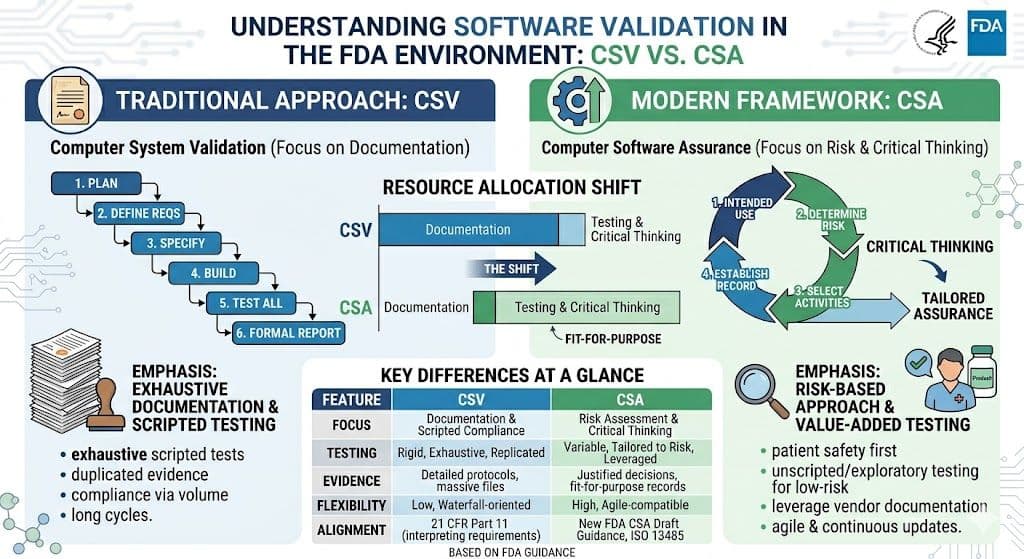
Traditionally, CSV follows a linear, waterfall-like path. It moves from planning and defining requirements to building, testing everything, and generating a formal report.
While thorough, CSV frequently defaults to an emphasis on exhaustive documentation and scripted testing.
- Exhaustive scripted tests: Every single feature requires a step-by-step script, regardless of risk.
- Duplicated evidence: Teams capture screenshots for every single step to prove the test occurred.
- Compliance via volume: Success is often measured by the thickness of the validation binder.
- Long cycles: The administrative burden delays software deployment for months.
Modern CSA: Smart, Risk-Based Assurance
The modern CSA framework turns the traditional model on its head. It replaces blind documentation with critical thinking and tailored assurance.
Instead of a rigid checklist, CSA operates in a continuous loop: Intended Use \(\rightarrow \) Determine Risk \(\rightarrow \) Select Activities \(\rightarrow \) Establish Record.
This framework shifts the emphasis to a risk-based approach and value-added testing.
- Patient safety first: Testing efforts directly target features that impact patient safety and product quality.
- Unscripted testing: Teams use unscripted or exploratory testing for low-risk features. This finds bugs faster.
- Leverage vendor documentation: Instead of re-testing everything, companies reuse the software vendor’s validation data.
- Agile updates: Less paperwork means software can be updated continuously and safely.
The Resource Allocation Shift
The core value of CSA is how it redistributes a project's time and talent.
TRADITIONAL (CSV): [================= DOCUMENTATION =================] [ Testing ]
MODERN (CSA):      [ Doc ] [================ TESTING & CRITICAL THINKING ================]
Under CSV, the vast majority of resources go toward creating and verifying documentation. Actual testing gets pushed to a tiny sliver at the end.
CSA flips this dynamic. It shrinks documentation to fit-for-purpose records, freeing up the majority of the team's time for testing and critical thinking.
Key Differences at a Glance
| Feature | Computer System Validation (CSV) | Computer Software Assurance (CSA) |
|---|---|---|
| Focus | Documentation & Scripted Compliance | Risk Assessment & Critical Thinking |
| Testing | Rigid, Exhaustive, Replicated | Variable, Tailored to Risk, Leveraged |
| Evidence | Detailed protocols, massive files | Justified decisions, fit-for-purpose records |
| Flexibility | Low, Waterfall-oriented | High, Agile-compatible |
| Alignment | 21 CFR Part 11 (interpreting requirements) | FDA CSA Guidance, ISO 13485 |
The Bottom Line
CSA is not a way to bypass FDA regulations. It is a smarter way to fulfill them. By shifting from a culture of "document everything" to "test what matters," medical device companies can adopt innovative digital tools faster, keep software secure, and ultimately better protect patient safety.