Human Factors Evidence, Right-Sized: Reading FDA's 2026 Final Guidance
FDA's final guidance on human factors content in marketing submissions sorts devices into three categories. Here is how critical tasks and the use-related risk analysis decide how much evidence to submit.
For years, medical device teams have asked the same question before a submission: how much human factors evidence does FDA actually expect to see? In late May 2026, FDA answered it more directly than ever. The final guidance on the content of human factors information in marketing submissions, announced in the Federal Register on May 29, 2026, gives manufacturers a risk-based framework for deciding what to submit, and it rewards teams that can explain their reasoning as much as teams that run more tests.
What changed, and what did not
The new guidance finalizes a draft that FDA first released in December 2022. It does not replace the 2016 guidance on applying human factors and usability engineering to medical devices. That document still describes how to do the work. The 2026 guidance describes what to put in the submission.
This distinction matters. Teams should not read the new guidance as permission to do less usability engineering. The process expectations in the 2016 guidance and in IEC 62366-1 (2015, amended in 2020) still apply. What changed is how much of that work FDA wants to review, and how a manufacturer can justify sending a summary instead of a full validation report.
The three submission categories
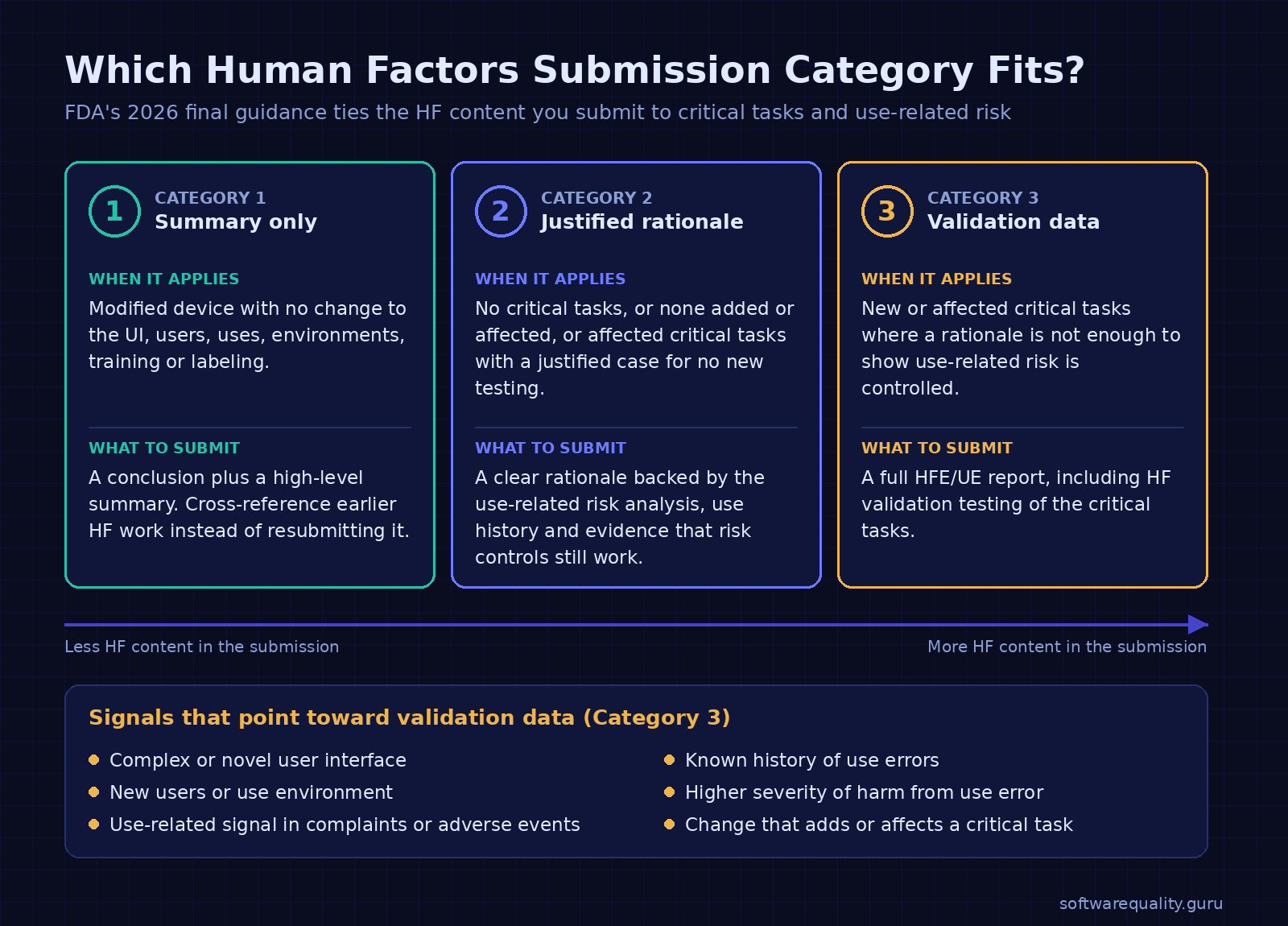
At the center of the guidance is a decision framework that sorts a submission into one of three categories:
- Category 1: A modification to a previously authorized device that does not change the user interface, intended users, uses, use environments, training, or labeling. A conclusion and a high-level summary are enough, and earlier human factors work can be referenced rather than resubmitted.
- Category 2: A new device with no critical tasks, a change that neither adds nor affects critical tasks, or a case where critical tasks are involved but the manufacturer has a solid rationale for not submitting new validation data. The submission needs a clear, evidence-based rationale.
- Category 3: Human factors validation data should be included. The submission needs a full human factors or usability engineering report covering validation of critical tasks.
The category determines the deliverable, so getting the category right early saves months of rework.
Critical tasks drive everything
FDA has long defined a critical task as one that could cause serious harm to the patient or user if done incorrectly or not done at all, with harm including compromised medical care. Under the new framework, the critical task list becomes the hinge for every decision.
That puts real weight on the use-related risk analysis. FDA expects it to identify all user tasks, separate critical from noncritical tasks, and draw on known use problems from complaints, recalls, adverse events, and published literature. For a modified device, the analysis must cover the finished device as a whole, not just the feature that changed. An analysis scoped only to the change can miss effects on upstream and downstream tasks, and reviewers treat that as a deficiency.
Practically, this means the use-related risk analysis should be tied closely to the ISO 14971 risk file, so that use errors, hazardous situations, and risk controls line up in both places.
The rationale path is now formal
One of the most useful changes is a new decision point that asks manufacturers to weigh user interface use history, familiarity and complexity, and how well existing risk controls work. Even when a change introduces or affects a critical task, new validation testing is not automatic. A manufacturer can justify skipping it with a thorough use-related risk analysis and other objective evidence that existing controls remain effective.
That is not a loophole. A rationale has to stand on evidence. A strong Category 2 rationale typically includes:
- A side-by-side comparison of the old and new user interface, step by step for each critical task
- Postmarket data showing the use history of the existing interface
- Evidence that existing risk controls still address each use error
- An explanation of why the change does not alter users, environments, or training
Validation data are more likely to be needed when the interface is complex or novel, the device has a history of use errors, the user population or use environment changes, or the potential severity of harm increases. FDA cites infusion pumps as an example of a device type with known use-error concerns.
510(k) submissions and predicates
Sharing an intended use with a predicate does not mean human factors testing can be skipped. Differences in technology, user interface, users, training, or environment can introduce new use-related risks that affect substantial equivalence. A useful practice is to compare the subject device interface against the predicate and similar devices, then document whether each difference touches a critical task. When the need for validation testing is genuinely unclear, a Pre-Submission is still the cleanest way to settle it.
Building the report FDA expects
The guidance keeps the human factors report outline previewed in the draft, with one structural change: the summary of preliminary evaluations now comes before the use-related risk analysis and critical task sections. The examples have also been expanded considerably, covering pediatric users, augmented reality interfaces, and devices with known use problems.
FDA also encourages reuse. Previously submitted human factors content does not need to be resubmitted and can be cross-referenced. That makes a well-organized usability engineering file a long-term asset across a product family.
Closing perspective
The 2026 guidance shifts the conversation from "Did you run a summative test?" to "Can you show why the evidence you submitted is the right evidence?" Teams that maintain a living use-related risk analysis, track postmarket use problems, and document interface changes task by task will find most submissions easier. Teams that treat human factors as a one-time test before launch will find the new framework exposes that gap quickly. Start each project by deciding the likely submission category, and let that decision shape the plan.